Aerodynamic Model Generation
No model? No problem.
Our MAVRIK simulator is designed to work with a wide range of vehicle model fidelity, from rapid low-fidelity lifting-line methods to high-fidelity aerodynamic data, or even cases where no existing model is available.
The tools below are used to generate aerodynamic models, mass properties, and propulsion models for your vehicle based on the needs of your application.
These tools are centered around low-fidelity methods that enable rapid development and are often sufficient for early design, control development, and simulation testing. In many use cases, this approach provides a strong first-order model without the time and cost of higher-fidelity analysis. When higher fidelity is required, MAVRIK can also incorporate externally generated data from CFD, wind tunnel testing, or other analysis methods.
Not sure which modeling approach is right for your vehicle or application? Schedule a meeting with our team, and we would be happy to discuss the limitations of each method and recommend an approach for obtaining a useful vehicle model without wasting development time.
MAVRIK model
MAVRIK is a versatile flight simulation environment capable of modeling a wide range of air vehicles using modular geometric definitions. Vehicles are constructed from individual components composed of basic geometries, allowing MAVRIK to estimate initial aerodynamic, mass, and inertia properties from simple vehicle inputs when detailed models are not yet available. This enables rapid evaluation of flight characteristics, control laws, and configuration changes during early design and concept development.
MAVRIK is not limited to internally estimated aerodynamics. The simulation environment can accept aerodynamic models across a wide range of fidelity levels, from quick first-cut estimates and low-fidelity lifting-line methods to high-fidelity CFD, wind-tunnel data, polynomial models, aerodynamic databases, or fully custom equations. This allows the same simulation framework to support early conceptual analysis, control law development, and detailed flight-test preparation as higher-quality data becomes available.
NAELL
NAELL (Numerical AeroElastic Lifting-Line) is an advanced aerodynamic analysis code designed to predict the forces and moments of fixed-wing aircraft with high efficiency and accuracy. Based on a method similar to the numerical lifting-line algorithm developed by Phillips and Snyder, NAELL extends traditional lifting-line capabilities to support complex and dynamic configurations.
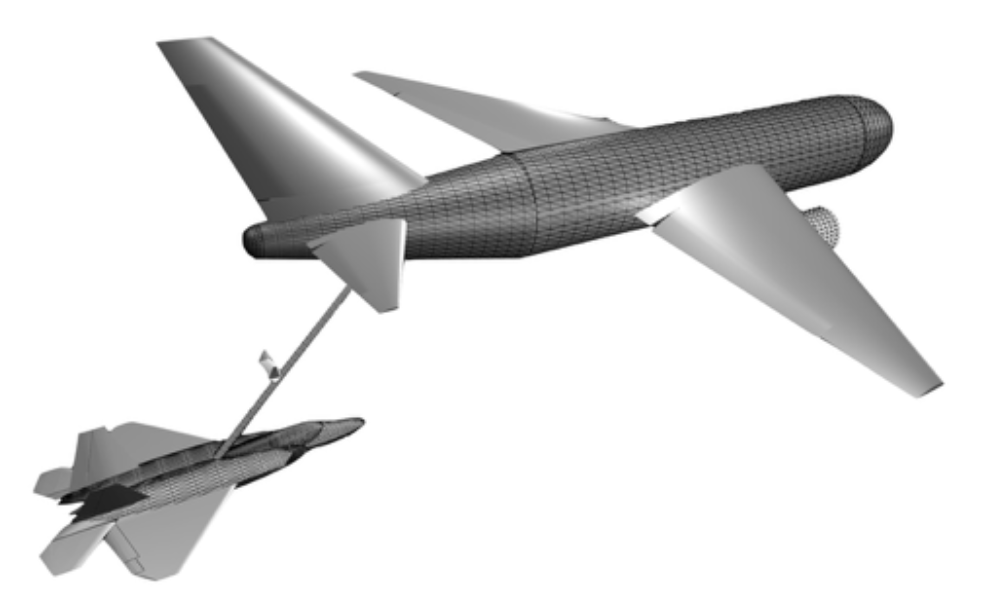
The system can model a wide range of aircraft geometries, each with multiple lifting surfaces featuring arbitrary sweep and dihedral angles. It also supports multi-aircraft simulations, allowing each aircraft to fly in unique orientations and angular rates while fully accounting for mutual vortex interactions between all lifting surfaces.
Currently, NAELL performs rigid-body aerodynamic analyses, providing both total aerodynamic loads and distributed loading data across wings and other lifting components. The framework is being further developed to incorporate aeroelastic effects, enabling coupled aerodynamic–structural simulations in future versions.

Key Features
NAELL is designed to deliver fast, flexible, mid-fidelity aerodynamic analysis across a broad range of aircraft configurations. Its architecture emphasizes adaptability, ease of integration, and an optimal balance between accuracy and computational speed, making it a powerful tool for both research applications and practical UAS development.
Supports Arbitrary and Complex Geometries – Analyze aircraft with multiple lifting surfaces, each with unique shapes, sweep, and dihedral.
Custom Control Surface Modeling – Define and evaluate control surfaces of any geometry to study control effectiveness and aerodynamic response.
Linear and Nonlinear Solution Methods – Choose between fast linear approximations or full nonlinear solutions for increased accuracy and fidelity.
Comprehensive Output Data – Obtain dimensional forces, moments, and load distributions across all lifting surfaces.
Aerodynamic Coefficients – Compute standard aerodynamic coefficients for use in simulation, analysis, or control development.
Multi-Aircraft Analysis – Simulate multiple aircraft flying in arbitrary directions and angular rates, including full vortex interactions between all lifting surfaces.
Inviscid and Viscous Load Components – Evaluate both inviscid and viscous contributions to total aerodynamic loads.
Angular Rate Effects – Account for dynamic aerodynamic effects due to angular motion and rotation.
High Performance – Delivers results an order of magnitude faster than many traditional aerodynamic solvers.
Object-Oriented Architecture – Designed for ease of scripting and customization, allowing seamless integration into your workflow or project pipeline.
Rapid Aerodynamic Database Generation – Quickly generate aerodynamic databases with respect to angles of attack, control surface deflections, and angular rates, enabling efficient use in flight dynamics and control simulations.
MachUp
Fast Aerodynamic Analysis of Fixed-Wing Aircraft
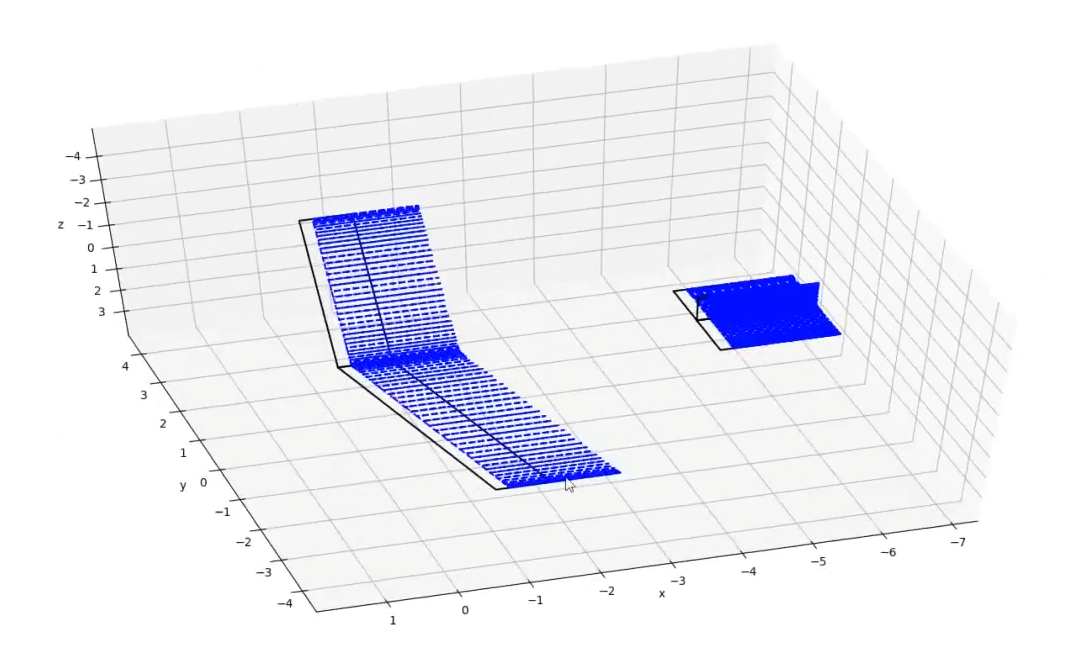
Implementation of the Goates-Hunsaker general numerical lifting-line method
Capable of dimensional and non-dimensional analysis
Easily generate and analyze wings with complex twist, sweep, and dihedral
Viscous airfoil modeling
STL, STEP, IGES, and VTK geometry creation
HI-Mach
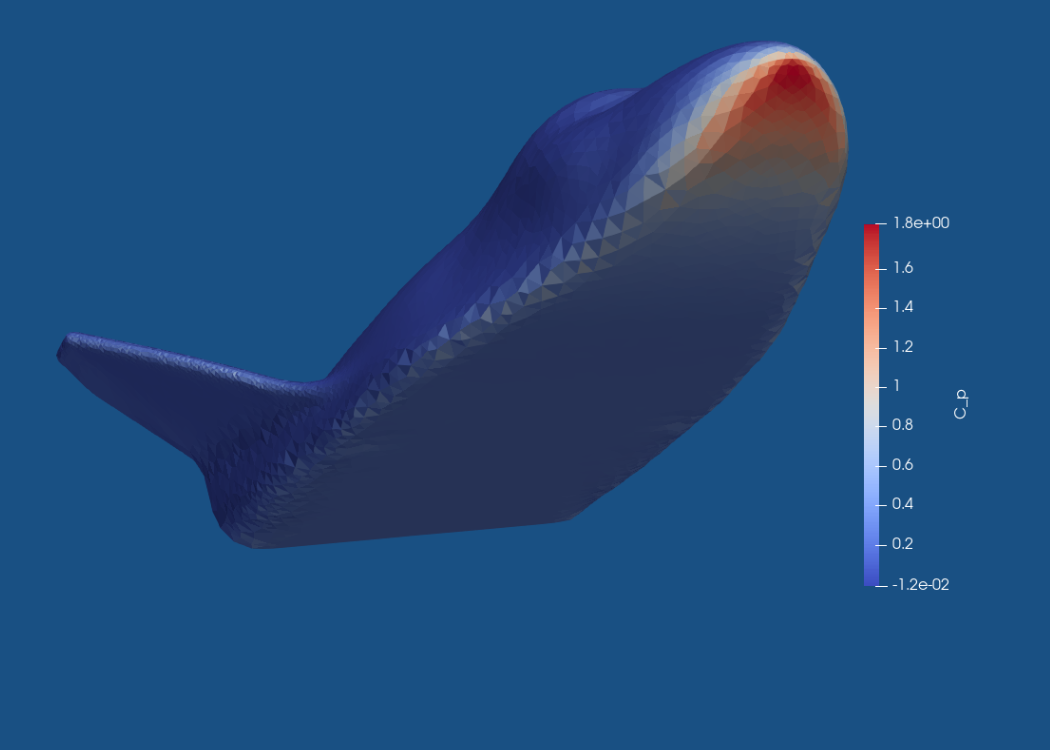
HI-MACH, the Hypersonic Impact Method for Aerodynamics and Convective Heating, is a fast engineering tool for estimating aerodynamic forces, surface pressures, and convective heating on hypersonic vehicles. It uses local surface-inclination methods and unstructured vehicle meshes to provide rapid, lower-fidelity predictions that are well suited for early design studies, trade analyses, and optimization. HI-MACH supports common mesh formats and can export results for visualization in ParaView, allowing engineers to evaluate vehicle performance without the computational cost of high-fidelity CFD.
PyProp
Blade Element Propeller Modelling
Battery-ESC-Motor-Prop Analysis
Database of COTS Components